AI Starts With Data: The Six Dimensions of Data Quality Every Finance Leader Should Understand

Over the past few months we've spent a lot of time discussing AI adoption in finance.
We've reviewed reports from PwC, CFO Connect, Intuit, Oracle NetSuite and others. While each report approaches AI from a different angle, they all seem to arrive at a similar conclusion:
AI success depends heavily on data quality.
AI models continue to improve rapidly, but they all share the same limitation: they can only work with the information they're given. If that information is incomplete, inaccurate, inconsistent, out of date, duplicated, or stripped of business context, the resulting outputs become less reliable.
In other words, AI doesn't solve data quality problems.
It exposes them and magnifies them.
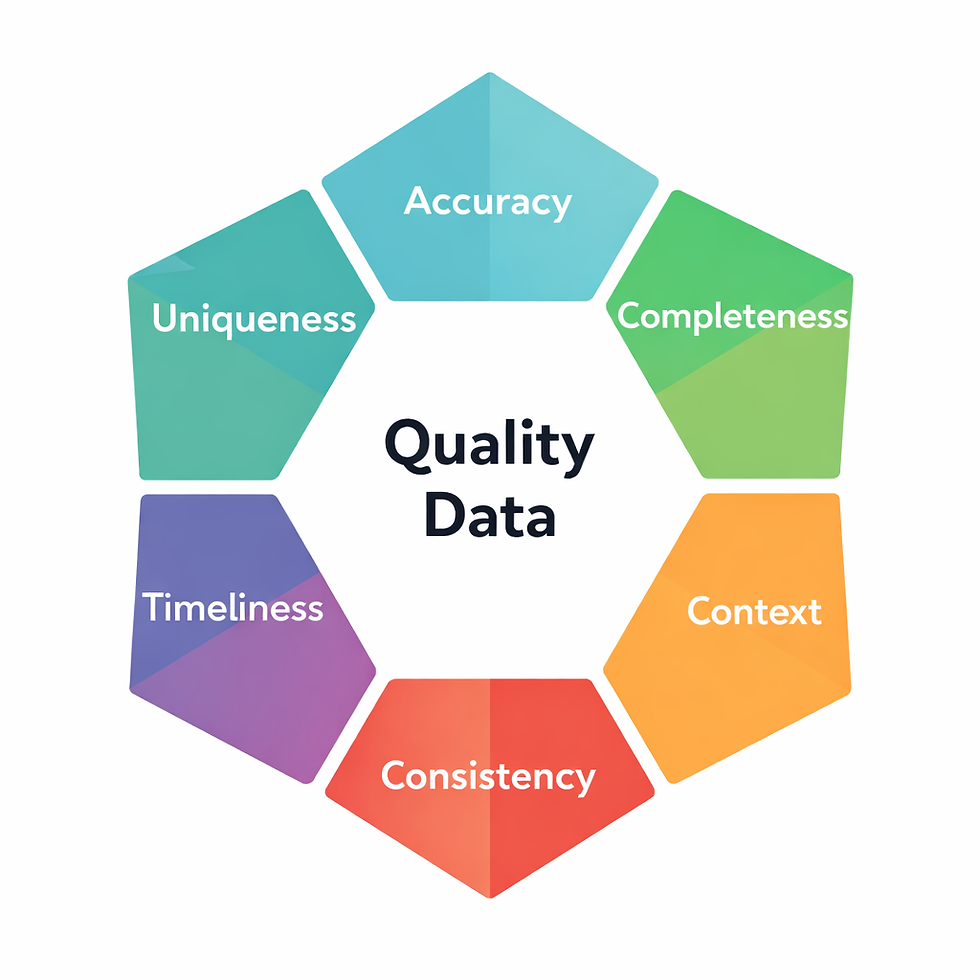
To better understand what "good data" actually means, it's useful to look at SAP's six dimensions of data quality:
Accuracy
Completeness
Consistency
Uniqueness
Context
Timeliness
While these concepts sound simple, they have profound implications for finance teams.
1. Accuracy: Small Errors Create Large Problems
Most finance organizations are reasonably good at capturing amounts, invoice dates and balances.
The challenge is that data quality failures often appear in less obvious places.
A payment date entered incorrectly can distort cash flow forecasts. A transaction classified under the wrong account can create misleading variance analysis. Costs allocated to the wrong period can affect management reporting.
These individual mistakes may appear insignificant in isolation, but collectively they distort the financial picture.
The challenge becomes even greater when AI enters the process. AI generally assumes that the underlying data is correct. If the inputs are wrong, the outputs will often be wrong as well—sometimes with remarkable confidence.
2. Completeness: Missing Data Is Hidden Risk
One of the most common misconceptions in finance is that a report can be considered high quality if the data it contains is accurate.
Not necessarily.
Imagine a bank reconciliation process where 90% of accounts are fully reconciled and perfectly matched. On the surface, everything looks healthy.
But if the remaining 10% of accounts are missing from the report entirely, the report is incomplete.
Missing data isn't neutral.
It represents hidden risk.
This appears regularly in finance through unreconciled accounts, incomplete consolidations, missing entities, or partially captured transactions. AI systems only amplify the problem because they will happily analyze whatever information they receive—even when important pieces are absent.
3. Consistency: The Most Underrated Dimension
Of all six dimensions, consistency may be the most misunderstood.
SAP defines consistency as ensuring data remains uniform across systems and sources.
A real-world example illustrates the challenge.
In one organization, finance reported revenue by customer billing address while the CRM reported revenue by sales ownership. Both reports were technically accurate. Yet they produced completely different regional performance results.
When a salesperson moved from EMEA to APAC and took their customers with them, CRM reported growth in APAC while finance continued attributing revenue to EMEA.
Same customers.
Same company.
Different story.
This is why I often say consistency is more important than accuracy.
Two slightly imperfect but consistent reports can still be compared.
Two perfectly accurate but inconsistent reports cannot.
4. Uniqueness: How Many Versions of Sales Exist?
Most people think uniqueness simply means eliminating duplicate records.
That's certainly part of it.
Duplicate customers, duplicate vendors, duplicate transactions, and duplicate chart of account entries all create confusion.
However, finance teams often encounter a more subtle version of the problem: duplicate definitions.
During one BI implementation I encountered multiple versions of what appeared to be the same metric:
Sales.
Revenue.
Gross Sales.
Net Sales.
Sales Before Costs.
Sales After Commissions.
Sales Excluding Fees.
Eventually I created a metric called "Accounting Sales" because it was the only version I trusted.
When organizations maintain multiple versions of the same metric, confidence in reporting declines and reconciliation work increases dramatically.
AI adds another layer of complexity because different systems may provide different answers to the same question.
5. Context: Data Needs Meaning
A number by itself rarely tells the full story.
Revenue increased 20%.
That's useful information.
But understanding whether that increase came from price increases, acquisitions, foreign exchange movements, one-time contracts, or changes in accounting treatment is often far more important.
Without context, even technically correct data can lead decision-makers toward incorrect conclusions.
This is an area where AI frequently struggles because models excel at identifying patterns but often lack the organizational and operational context necessary to explain why those patterns exist.
Good finance teams don't merely provide numbers.
They provide meaning.
6. Timeliness: Accurate Data Delivered Too Late Has Limited Value
Data can be accurate, complete, consistent, unique and properly contextualized.
If it arrives too late, it may still be ineffective.
Finance teams constantly face the tension between speed and precision.
Close processes, reconciliations, approvals and adjustments all improve accuracy, but they also consume time.
Meanwhile the business continues making decisions.
One of the most promising applications of AI in finance is improving the timeliness of reporting, forecasting and analysis. However, achieving those benefits requires organizations to first build strong underlying data foundations.
AI cannot accelerate information that does not exist.
TheCFOAI Take
The conversation around AI often focuses on models, agents, copilots and automation.
Those topics are important.
But after reviewing dozens of AI deployments, reports and case studies, I continue to arrive at the
same conclusion:
The biggest constraint on AI adoption is rarely the AI itself.
It's the quality of the underlying data.
The organizations seeing the greatest success with AI are typically not the ones experimenting with the most tools. They're the ones that have spent years building centralized systems, standardizing definitions, improving governance, and creating reliable information flows.
In other words, they've done the hard work.
Before finance leaders ask how AI can transform their organization, they should first ask a simpler question:
How good is our data?
Because in the end, AI is only as smart as the information it receives.