ERP, AI and the Single Source of Truth


For years, companies have talked about creating a “single source of truth.”
There’s a reason the phrase became so popular.
Go back far enough and, for many organizations, the source of truth was relatively obvious: it was the ERP.
Then came the SaaS explosion.
Sales wanted a better CRM. HR wanted its own HRIS. Marketing wanted specialized analytics. Procurement, payments, expenses, customer success and virtually every other corporate function found software designed specifically for their needs.
And individually, many of those decisions made perfect sense.
Collectively, however, they created a problem.
Companies ended up with multiple versions of the truth.
When Everyone Is Right
This is where the problem becomes more complicated than simply having “bad data.”
Imagine Salesforce says sales in EMEA are growing, while finance says they're flat.
Or the HR system says the company has 15 R&D employees while payroll says there are 22.
Which system is wrong?
Potentially neither.
A CRM may define a region based on the sales team responsible for an account, while finance classifies it according to the customer's billing address. HR might use detailed organizational structures while payroll has to fit employees into more rigid regulatory categories. Financial reporting may introduce yet another definition based on accounting requirements.
Each system can contain perfectly accurate data according to its own rules. Yet put them together and the organization no longer has a single version of reality.
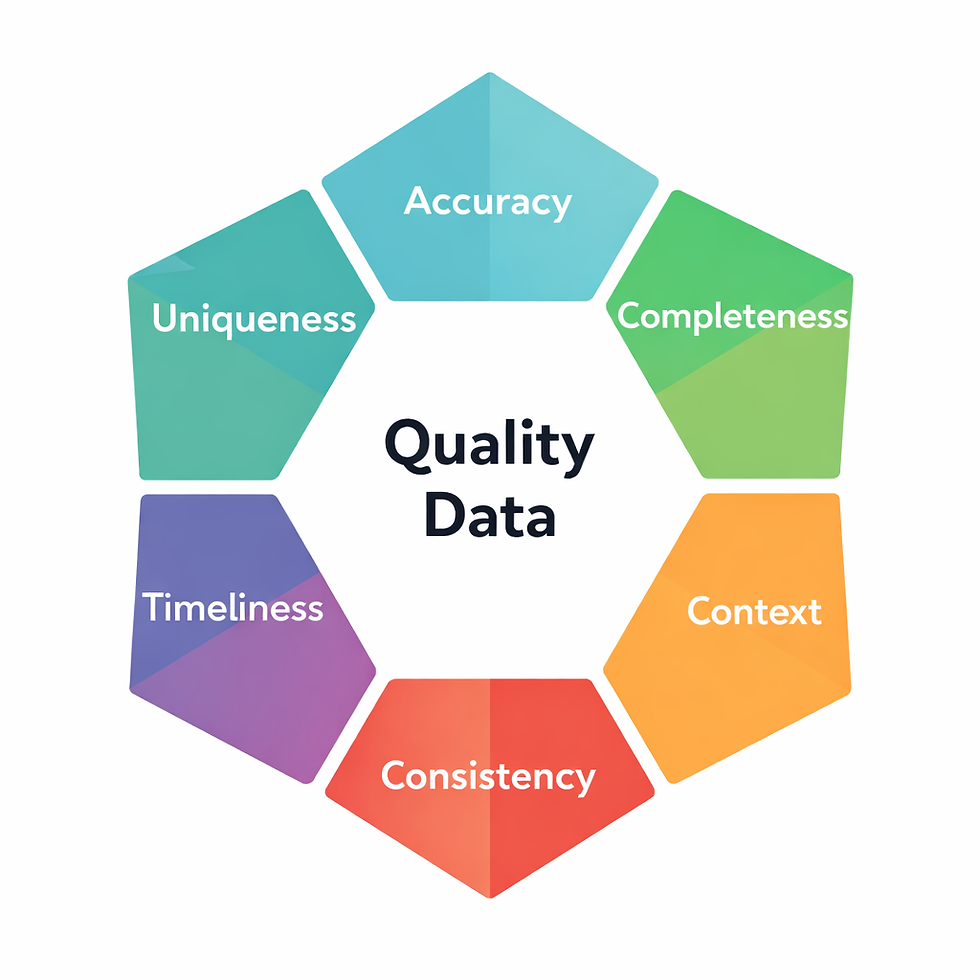
We've covered this problem before in our series on SAP's six dimensions of data quality: Accuracy, Completeness, Context, Consistency, Timeliness and Uniqueness. Multiple sources of truth can degrade virtually every one of them.
And for years, finance teams have dealt with the consequences using one remarkably persistent piece of technology:
Excel.
Highly paid employees spend hours extracting information from different systems, reconciling definitions, mapping fields and massaging spreadsheets until management finally receives something resembling a consolidated view of the business.
In effect, people become the integration layer.

The ERP vs. Features Dilemma
I've often thought of this as the Single ERP vs. Features dilemma. A broad ERP such as NetSuite can provide one centralized environment for much of the company's operational and financial information.
The problem is that a jack-of-all-trades system is rarely the best tool for every department.
Finance may be perfectly happy with the ERP. Operations may tolerate it. Then Sales wants Salesforce and HR wants its HiBob etc.
Whenever a department finds a specialized SaaS product with features the ERP can't match they make an argument that is perfectly reasonable: the additional functionality creates more value than whatever is lost through fragmentation.
For much of the 2010s, features won that argument.
Better APIs and connectors made that choice easier. Companies could assemble increasingly sophisticated software stacks while convincing themselves that everything could ultimately be connected.
Sometimes it could.
Sometimes it couldn't.
But AI may be forcing us to revisit that tradeoff.
AI Changes the Economics of Fragmented Data
Almost every discussion about enterprise AI eventually comes back to data.
And for good reason.
Companies are understandably excited—and nervous—about AI. Nobody wants to discover five years from now that competitors built enormous productivity advantages while they were still experimenting with ChatGPT.
Yet we've also seen plenty of evidence that scaling AI across organizations remains difficult.
Some of that comes from the technology itself. Hallucinations, reliability and the statistical nature of generative AI remain real limitations.
But there's also a much older problem:
Garbage in, garbage out.
And having five different versions of the truth is a particularly nasty form of garbage.
An AI system asked to analyze EMEA sales needs to know what “EMEA sales” actually means.
If CRM, finance and the data warehouse each provide a different answer, connecting an AI model to all three doesn't magically reconcile them.
We've given the AI the same problem our analysts have been fixing manually in Excel for years.
Except now we're expecting the machine to make decisions from it.
TheCFOAI Take: Could AI Push Companies Back Toward Consolidation?
This is where AI could have an interesting secondary effect on enterprise software.
For the past decade or more, the direction of travel has largely been toward specialization: more SaaS applications, more best-of-breed tools and more integrations connecting them.
AI may increase the cost of that strategy.
If companies genuinely want AI agents analyzing data, executing workflows and eventually operating across departments, then consistent definitions and reliable data become much more valuable.
Suddenly the old-fashioned virtue of the centralized ERP looks considerably more attractive.
That doesn't necessarily mean companies should rip out every specialized application and put everything back into one giant system. Specialized software exists for a reason, and in many cases its advantages will continue to outweigh the costs of fragmentation.
But the calculation has changed.
For years the question was:
Are the additional features worth adding another system?
In the AI era, companies may increasingly need to ask:
Are those additional features worth creating another source of truth?
If AI really does become embedded throughout the enterprise, reducing the number of systems, standardizing definitions and consolidating data may turn out to be some of the most important AI work companies can do.
Not because consolidation is exciting.
But because before AI can understand your business, your business needs to agree with itself.